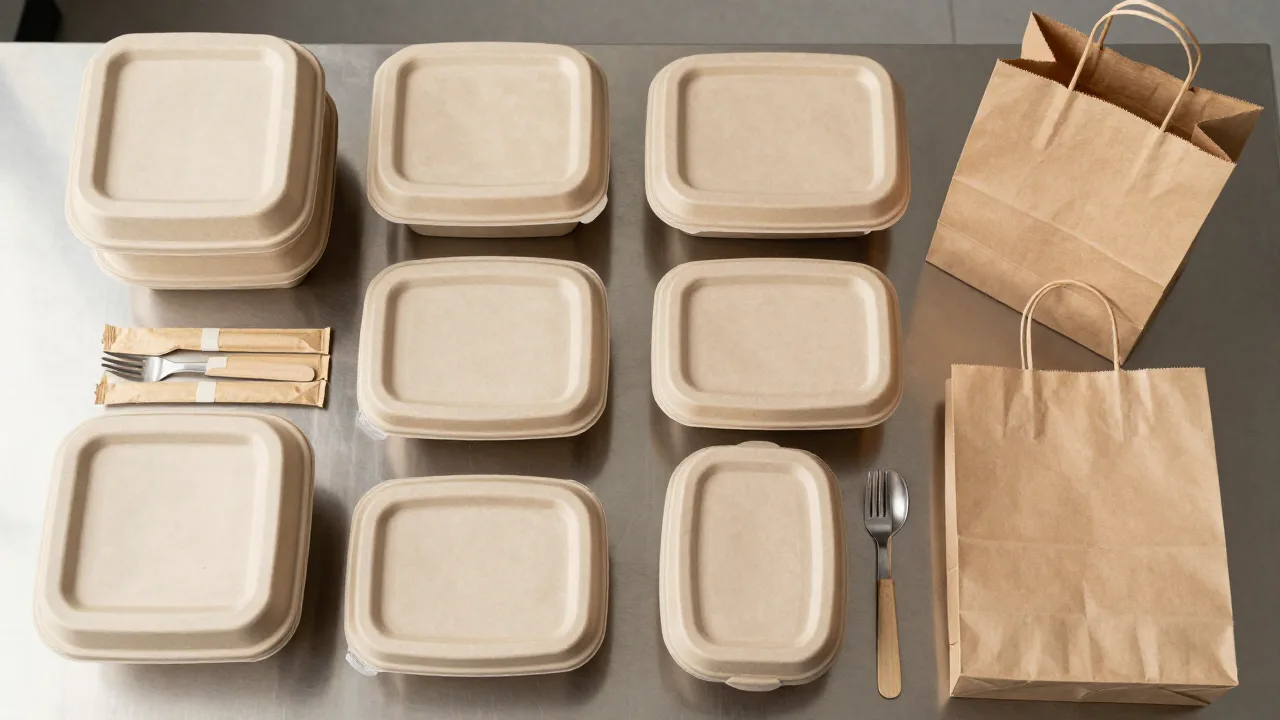
Ask a restaurant owner their food cost and you'll get an answer in three seconds. Ask their labor percentage and you'll get it in five. Ask what they spend on packaging per takeout order and the room goes quiet — because almost nobody tracks it, even though it's now the third-largest variable cost in an off-premise-heavy operation.
That silence is expensive. Disposables pricing has moved a lot since 2023: fiber and molded-pulp containers are up sharply, compostable lids more than most, and a growing list of jurisdictions has banned expanded polystyrene outright, forcing operators into materials that cost two to three times what they were paying. Meanwhile, the number of orders that need packaging has grown enormously at the typical independent restaurant.
So the leak compounds from both ends: higher unit cost, more units. And because packaging usually hides inside a "paper goods" or "supplies" line that nobody reconciles against order counts, it can drift 40% upward over two years without anyone noticing.
Here's what makes it worse. Every dollar of packaging is a dollar of pure cost with no upside potential — you can't upsell a lid. When your packaging runs $2.10 per order on a $27 average ticket, that's 7.8% of revenue gone before food, before labor, before rent. On 4,000 to-go orders a month, trimming that to $1.50 puts $2,400 a month — nearly $29,000 a year — straight into operating profit. Same food, same guest experience, same everything.
The good news: packaging waste is unusually easy to find, because it clusters in five predictable places. Let's get your baseline first, then go hunting.
Step 1: Calculate Your Real Number
Start with the crude version, because it takes ten minutes and it's usually enough to tell you whether you have a problem.
Pull three months of invoices from every disposables supplier — containers, lids, bags, cutlery, napkins, cups, labels, sauce cups, and the carry-out portion of your paper goods. Divide the total by the number of to-go orders in that same period. That's your blended packaging cost per order.
| Concept Type | Healthy Range Per Order | Warning Sign |
|---|---|---|
| Quick-service / counter | $0.75–$1.30 | Above $1.60 |
| Fast casual, full entrées | $1.10–$1.90 | Above $2.20 |
| Full-service takeout | $1.60–$2.40 | Above $2.90 |
| Family meals / bulk | $2.50–$4.20 | Above $5.00 |
Now the version that actually finds money: cost the top ten menu items individually. Lay out every piece of packaging that leaves with a single order of your best-selling entrée — the entrée container, the lid, the sides cup, two sauce cups, the utensil pack, the napkin bundle, the bag, the label, the sticker seal — and price each one from your invoice. Not the case price. The each price.
This is where people gasp. A single "cheap" clamshell that costs $0.34 becomes a $1.85 packaging bill by the time the lid, two 2-oz sauce cups at $0.09 apiece, a cutlery kit at $0.21, a 12″ bag at $0.16, and a tamper seal at $0.05 pile on. If you want to run these numbers against case pricing quickly, a unit price calculator turns case cost and pack count into a per-each figure in seconds, which is the only unit that matters for this exercise.
Rule of thumb: if you can't state your packaging cost for your three best-selling to-go items to the penny, you are overspending on at least one of them.
Where the Money Actually Leaks
Once you have per-item numbers, the waste tends to sit in five buckets. In audits I've walked through, these five explain the overwhelming majority of overspend.
1. Containers sized for the biggest possible portion
Most kitchens standardize on one or two container sizes for simplicity, which means a 6-oz side of slaw goes into a 16-oz container because that's what's on the shelf. You pay for the container and the food quality suffers, because a half-empty container lets contents slide and steam. Moving to a proper three-size ladder (8 / 16 / 32 oz) typically cuts container spend 12–18% on its own.
2. Utensils, napkins, and condiments issued by default
This is the single fastest win available to any restaurant. When cutlery is opt-in at checkout rather than automatic, take rates fall to somewhere between 30% and 45%. At $0.21 per kit on 4,000 orders, that's roughly $500 a month recovered from a checkbox. Same story with napkins bundled six at a time and sauce cups handed out in pairs "just in case."
3. Double-bagging and oversized bags
Staff double-bag when they don't trust the bag. It's a rational response to a bag that fails, and it silently doubles your bag line. The fix is to buy one grade heavier and one size smaller — a sturdier 10″ bag beats two flimsy 12″ bags on both cost and handling.
4. Buying the wrong way, not the wrong thing
Split cases, emergency runs to the restaurant supply store, and single-vendor complacency add 8–15% to unit cost. Restaurants that consolidate SKUs, commit to a quarterly volume, and get three competitive quotes annually routinely see double-digit reductions without changing a single product.
5. Failure packaging
Every leaked container, crushed clamshell, or soggy delivery generates a remake, a refund, or both. That's packaging cost plus food cost plus labor. Cheap packaging that fails 2% of the time is more expensive than good packaging that fails 0.2% — which is exactly why cost-cutting has to be paired with what you already know about to-go food quality preservation. Vented lids and grease-resistant liners aren't luxuries; they're failure insurance.
The 30-Day Reduction Plan
You don't need a procurement department. You need four weeks and some discipline.
Week 1 — Measure. Build the blended number, then cost your top ten items individually. Print the per-item costs and post them in the pack station. Awareness alone shifts behavior; staff who see "$1.85" next to a dish stop grabbing the extra sauce cup.
Week 2 — Right-size. Audit every container against actual portion weight. Anything running under 60% full gets moved down a size. Consolidate near-duplicate SKUs; most kitchens are carrying two or three containers that do the same job because someone ordered a substitute once and it stuck.
Week 3 — Make extras opt-in. Turn cutlery, napkins, and condiments into checkbox items in your online ordering flow, and coach phone staff to ask rather than assume. Set a standard: one napkin per entrée, one sauce cup per item that needs it, utensils only on request.
Week 4 — Renegotiate. Take your consolidated SKU list and quarterly volume to three suppliers. Ask specifically about committed-volume pricing and own-brand equivalents. Then set a monthly cost-per-order report so the number never drifts again unmonitored.
One thing worth doing during week two: look at the menu itself. Certain dishes are structurally expensive to package — anything saucy, anything crispy, anything requiring three separate components. Your to-go menu design and profitability work should account for packaging cost per dish the same way it accounts for food cost. Sometimes the right answer isn't a cheaper container; it's promoting the dish that travels well and quietly de-emphasizing the one that needs a $2.40 packaging kit.
Example scenario: a family-owned Chinese restaurant cutting packaging cost 32%
Illustrative scenario — a composite example built to show how the numbers work. It does not describe a real business or customer.
Consider a family-owned Chinese restaurant doing roughly 3,600 to-go orders a month, running $2.31 per order in packaging — 8.4% of its $27.50 average to-go ticket. A four-week audit finds three culprits: every order gets two sets of chopsticks and a fork regardless of party size, all rice sides go into 32-oz containers regardless of portion, and staff double-bag 70% of orders because the standard bag tears. It moves to opt-in utensils at online checkout, adds a 16-oz rice container, and upgrades to a heavier 10″ bag that costs $0.04 more but eliminates double-bagging. Packaging cost per order falls to $1.58 in eight weeks — a 32% reduction worth about $2,630 a month. Guest complaints about packaging actually drop, because the heavier bag stops failing in customers' cars.
Where Cutting Costs Backfires
Now the counterweight, because reckless packaging cuts destroy more value than they save.
Never cut the container that touches hot, saucy, or fried food. That's where failure rates live. A $0.12 savings on an entrée container that leaks once per fifty orders costs you a $19 remake plus a customer who tells six people.
Never make the guest do arithmetic. If your opt-in flow buries the cutlery checkbox or defaults to "none" without saying so, you'll trade $500 in savings for a wave of one-star reviews about missing forks. Make the choice visible and explicit.
Never let cost-cutting override compliance. Foam bans, compostability mandates, and labeling rules are jurisdiction-specific and carry real fines. Before switching materials to save money, confirm what's legal where you operate. The tradeoffs between cost, performance, and compliance in current materials are laid out well in this guide to eco-friendly packaging, and it's worth checking against your local rules before you place a big order.
Never assume sustainable means expensive. The premium on molded fiber and PLA-lined board has narrowed considerably as volume has scaled. In several categories, compostable is now within 5–10% of conventional — sometimes cheaper at committed volume. Our breakdown of sustainable takeout packaging options covers where the price gap has closed and where it hasn't, and there are customer-perception gains described in the eco-friendly packaging guide that offset part of any remaining premium.
Keep It From Drifting Back
Packaging costs creep. Suppliers raise prices quietly, staff habits relax, and a new menu item arrives with a bespoke container nobody costed. Three habits prevent the slide:
- Report cost-per-order monthly alongside food and labor. One number on one line. If it moves more than 5% in a month, find out why that week, not next quarter.
- Cost the packaging before you launch any new menu item. Make it part of the recipe card, not an afterthought at the pack station.
- Re-quote annually. Not because you'll switch suppliers, but because the quote itself usually earns you a better price from the one you have.
Packaging will never be the most exciting line on your P&L. But it's one of the very few places where a few focused weeks of attention produces a permanent, compounding reduction that no guest ever notices — and in a business where most cost savings hurt somewhere, that's rare enough to be worth the effort.
Frequently Asked Questions
What is a good packaging cost per takeout order?
How do I calculate packaging cost per order?
Does making utensils opt-in really save money?
Is compostable packaging still more expensive?
Where should I never cut packaging cost?
See Your Real Cost Per Order, Every Month
KwickOS ties online ordering, inventory, and supply costing together so packaging spend shows up as a tracked number next to food and labor — not a mystery line on a supplies invoice.
Try KwickOS free — 5,000+ restaurants trust usHelp Local Restaurants Find Hidden Margin
KwickOS resellers earn recurring margin helping independent operators put real numbers behind their off-premise costs.
Become a Reseller