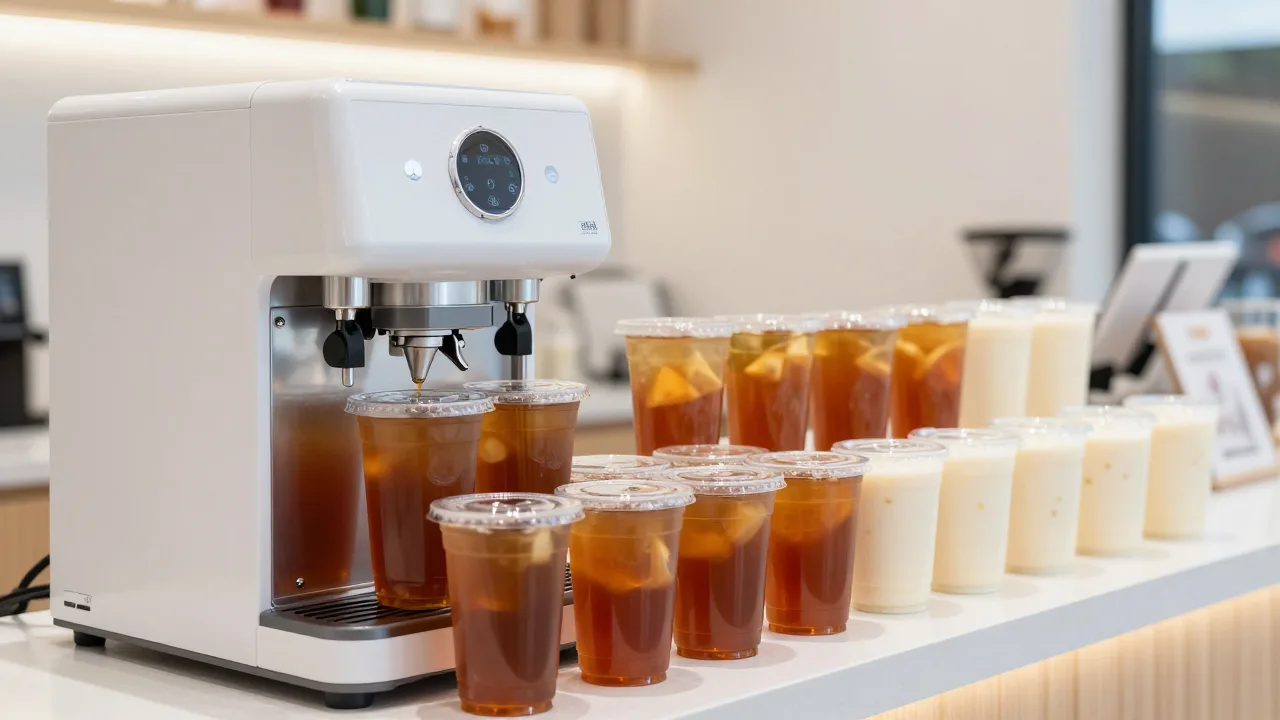
Consider two numbers side by side. A fountain soda costs you about $0.28 and sells for $3.49 — roughly 92% gross margin. A large iced latte costs about $1.05 and sells for $6.25. Nothing else on your menu comes close. And yet a startling share of restaurants either don't offer drinks on to-go orders at all, or offer them and quietly hope nobody orders one.
The reason isn't mystery. It's the snap-on lid. A press-fit lid on a cup of iced tea, riding in a cardboard tray on a car passenger seat, is a promise the packaging cannot keep. It leaks at the first hard turn, and when it leaks it doesn't just ruin the drink — it soaks the bag, ruins the food, and generates a refund for the entire order plus a one-star review. One $4 drink can cost you $38 and a customer.
So operators reason, not unreasonably, that beverages aren't worth the risk off-premise. Which means they voluntarily surrender the highest-margin category they sell, on the fastest-growing half of their business. On 3,000 to-go orders a month, capturing drinks on just 35% of them at a $2.80 contribution adds roughly $2,940 in monthly gross profit — with no new menu, no new labor, and no new equipment beyond a sealing machine.
The whole thing turns on solving five logistics problems. Solve them and drinks go from a liability to the best margin line in your off-premise business.
Problem 1: The Seal
Start here, because it's the one that makes the rest possible. Film sealing — the technology bubble-tea shops standardized on twenty years ago — replaces the snap lid with a heat-bonded plastic film across the cup rim. The customer punches through with a straw. It does not leak when tipped, dropped, or inverted.
The economics are unusually friendly:
| Item | Cost | Notes |
|---|---|---|
| Manual sealing machine | $400–$700 | Foot or hand lever; 4–6 sec per cup |
| Semi-automatic sealer | $800–$1,800 | Auto-index, 2–3 sec per cup, higher volume |
| Sealing film (per cup) | $0.02–$0.04 | Cheaper than most snap lids |
| Compatible cups | $0.09–$0.18 | Rim must match the machine's die |
Note that film is usually less expensive than the lid it replaces. The machine pays for itself in avoided refunds, typically inside three months for a shop doing meaningful drink volume. The two setup gotchas: the cup rim diameter must match the sealing die exactly (90mm and 95mm are the common standards, and they are not interchangeable), and you need about 18 inches of counter with a dedicated outlet near the pour station — not across the kitchen.
Sealed cups also unlock delivery. A drink that survives a fifteen-minute car ride upside down is a drink you can sell on a marketplace app without dreading the refund queue.
If you sell iced drinks to go and don't seal them, you are not selling beverages off-premise. You're running an experiment on your customers' upholstery.
Problem 2: Ice, Dilution, and the Twelve-Minute Window
A sealed drink still degrades. Standard ice in a 20-oz cup loses meaningful integrity in about 12 minutes, and by 25 minutes an iced coffee is noticeably watery. That's a quality failure the customer blames on your recipe, not on physics.
Four practical countermeasures, in rough order of cost:
- Build drinks last. Sequence beverages after the food is bagged, not first. This alone recovers five to eight minutes of ice life, and it's free.
- Switch to larger-format ice for to-go. Cube or cylinder ice has far less surface area than nugget or flake, and melts a great deal slower. Many operations run nugget for dine-in and cube for takeout from the same machine line.
- Concentrate the base on scheduled orders. For drinks going out on advance or delivery orders, brewing the base slightly stronger compensates for predictable dilution. Boba shops have done this for years.
- Offer ice-on-the-side for delivery. A sealed cup of concentrate plus a separate small cup of ice arrives perfect. It's a small packaging premium and delivery customers appreciate the intent.
Hot beverages have the mirror problem: a paper cup with a sip lid loses about 20°F in fifteen minutes, and coffee below 140°F reads as lukewarm. Double-wall cups, tight-fitting lids, and — critically — not pouring until the order is otherwise complete solve most of it. The same holding-window discipline that governs to-go food quality preservation applies to liquids; the only difference is that beverages fail faster and more visibly.
Problem 3: Carriers and the Physics of a Car Seat
The most common beverage failure isn't the lid at all — it's the cup tipping in transit because it was never restrained. Flimsy pulp trays flex, drinks tilt, and even a sealed cup that lands on its side pushes condensation into a paper bag.
Three rules cover it:
Rigid four-cup carriers, not two-cup pulp trays. The four-cup design distributes weight and resists flex. Even single-drink orders travel better in a rigid holder than loose in a bag.
Never bag drinks with food. Condensation from a cold cup will soak a paper bag from the inside in under ten minutes, and a hot cup will steam a sandwich. Drinks travel in their own carrier, handed over separately, every time.
Handle bags for anything over two drinks. A carrier with four full cups weighs about four pounds; expecting a customer or driver to balance that under one arm while carrying a food bag is how spills happen twelve feet from your door.
Problem 4: Sequencing at the Station
Beverages are the most commonly forgotten item on a to-go ticket, because they're made at a different station than the food and there's rarely a step that forces reconciliation.
The fix is procedural, not technological, though technology helps. Route drink items to a beverage display or printer at the pour station, and make the final bag check a two-item verification: food bag plus drink carrier, both physically touched before the order is staged. Some operations hang the drink carrier on the same numbered hook as the food bag so an incomplete order is visually obvious.
Volume changes the calculus. Once you're producing more than a handful of drinks per rush, individual production stops working and you have to think in batches — four iced teas built in one pass rather than four separate trips to the tea urn. That's the same principle as order batching efficiency on the food side, and it's the difference between a drink station that keeps up and one that becomes the bottleneck for the whole rush. Shops that treat beverage throughput as a design problem rather than a staffing problem get a lot of useful ideas from this breakdown of drink shop speed of service, where the entire menu is beverages and every second is engineered.
One more sequencing note: drinks are also what makes your ready-time promise honest. If the food is bagged at minute nine and the drink isn't poured until minute fourteen, your pickup notification either fires early — leaving the customer standing there — or fires late. Trigger the ready message on the complete order, not on the food.
Example scenario: a 40-seat cafe tripling drink attachment with a $640 sealer
Illustrative scenario — a composite example built to show how the numbers work. It does not describe a real business or customer.
Consider a 40-seat cafe doing about 2,400 to-go orders a month, with drink attachment on only 12% of takeout tickets and roughly 22 refunds a month for spills. In April 2026 it buys a $640 manual sealer, switches its to-go cups to a 95mm sealable rim, moves to rigid four-cup carriers, and changes the build order so drinks are poured after bagging. It also adds a one-tap drink prompt at online checkout. Within ten weeks, drink attachment rises to 34% of to-go tickets, spill refunds fall to two per month, and beverage revenue on off-premise orders goes from about $1,010 to $3,180 monthly. Net of film and cup costs, the sealer pays for itself in 22 days. The unexpected finding in this example: sealed iced drinks become the top-rated delivery item, because customers had never received one intact from any restaurant before.
Problem 5: Nobody Asks for the Drink
Even with perfect logistics, attachment stays low if the ordering flow doesn't prompt. In-person, a cashier asks. Online, silence is the default — and silence sells nothing.
What actually moves the number:
- A one-tap prompt after the entrée is added, showing two or three drinks with images. Not a menu category the guest has to go find.
- Bundle pricing that's visibly cheaper — entrée plus drink at $1 off is a clearer decision than two separate prices.
- Photos, always. Beverages are the most visually-driven category on any menu; a sealed cup of milk tea with visible pearls sells itself.
- A named house specialty. One signature drink with a name and a story outperforms a list of generic options, and it's the thing customers reorder.
That last point is worth dwelling on. High-margin specialty beverages are where the real money sits — a well-run cold brew program routinely delivers 80%+ margins with almost no labor per serving, and the economics of cold brew and nitro are strong enough to justify the batch equipment on their own. Pair a signature drink with the broader to-go upselling strategies you're already using on sides and desserts, and you're adding margin to tickets you were going to fill anyway.
For the wider strategy question — what to put on the menu, how to price tiers, and which formats fit which concepts — our takeout beverage program strategy piece covers the merchandising side that this logistics guide deliberately skips.
Get the seal, the ice, the carrier, the sequence, and the prompt right, and beverages stop being the category you avoid off-premise. They become the one that quietly rescues your margin.
Frequently Asked Questions
How much does a cup sealing machine cost?
Do sealed drinks really stop spills in delivery?
How do I keep iced drinks from getting watery?
Should drinks go in the same bag as the food?
How do I increase drink attachment on online to-go orders?
Sell the Highest-Margin Item on Your Menu, To Go
KwickOS routes drink items to the pour station, prompts for beverages at online checkout, and holds the ready notification until the whole order — food and drinks — is actually complete.
Try KwickOS free — 5,000+ restaurants trust usBring Beverage Margin to Shops in Your Market
KwickOS resellers earn recurring margin helping cafes, boba shops, and restaurants build off-premise drink programs that hold up in transit.
Become a Reseller