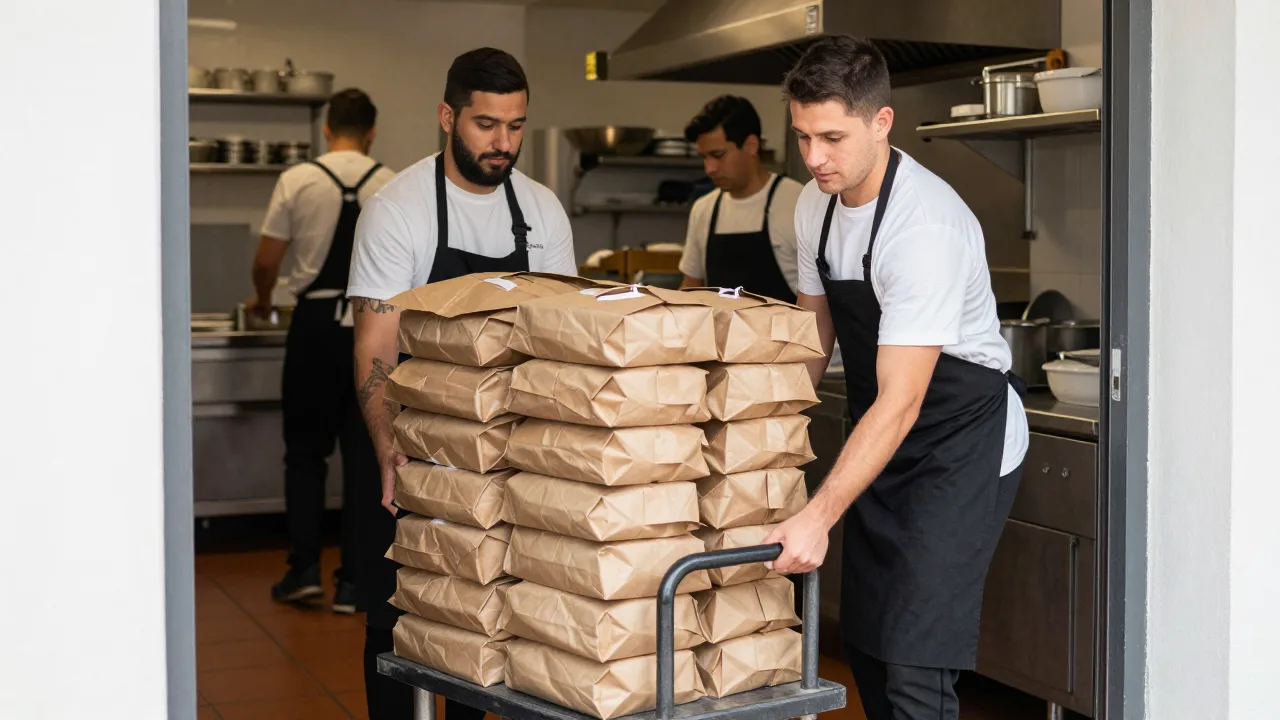
11:52 a.m. The phone rings. Someone from the insurance office two blocks over needs lunch for 32 people, and they'd like to pick it up at 12:15. Your line cook hears the ticket print and goes pale. Your regular Tuesday rush is about to arrive. And you, being a business owner who likes money, say yes.
What happens over the next twenty-three minutes decides whether that order was worth taking. Done well, a 32-person office lunch is a $520 ticket with better margins than your dining room, delivered in one handoff, from a customer who will call again every other week. Done badly, it's a $520 ticket that costs you eleven walk-in guests, two bad reviews, and a line cook who quits in September.
The trap is subtle. Bulk orders don't fail because kitchens can't cook 32 entrées. They fail because the order gets treated as one enormous ticket in the same queue as everything else — and a single ticket that occupies your entire line for eighteen minutes is functionally a service outage. Every other guest waits behind it.
Here's the reframe that fixes almost everything: a large to-go order is not a big order. It's a different product. Different intake, different lead time, different prep path, different packaging, different handoff, different pricing. Once you build that second lane, bulk stops competing with your regular service and starts subsidizing it.
Define Your Bulk Threshold — In Writing
Everything downstream depends on one decision: at what point does an order stop being takeout and become bulk? Most operations land somewhere between 10 and 15 entrées, or a dollar threshold around $150–$250.
Pick the number, write it down, and put it in three places: your phone script, your online ordering rules, and the wall of your kitchen. Then attach real policies to it.
- Advance notice. Same-day is fine up to a point; the question is how much of a point. A common ladder: 10–20 entrées needs 2 hours, 21–50 needs 4 hours or prior day, 50+ requires 24 hours.
- Cutoff windows. No bulk pickups scheduled between 11:45 and 1:15, or whenever your peak actually sits. Offer 11:15 or 1:30 instead — most offices are flexible if you ask at intake.
- Deposit or prepayment. Bulk no-shows are catastrophic in a way single orders never are. A 25–50% deposit on anything over $300 is standard and rarely questioned.
- A hard change deadline. "Headcount can change until 4 p.m. the day before" prevents the 11:40 a.m. call that adds eight entrées to a locked prep list.
The policy isn't there to say no. It's there so your staff can say yes without a manager, and so a well-meaning "sure, no problem" at 11:52 doesn't become an operational decision nobody signed off on.
Intake: Capture Everything the First Time
Nearly every bulk disaster traces back to incomplete intake. The office manager said "assorted" and nobody asked what that meant. Nobody asked about the vegetarian. Nobody confirmed whether serving utensils were needed, or who exactly is picking up, or whether they're driving a sedan.
Build a fixed intake checklist and refuse to close the call without it:
- Headcount and exact item breakdown, read back item by item
- All allergies and dietary restrictions, labeled per item
- Pickup time and the time they need to be eating (these differ, and the second one is the real deadline)
- Pickup person's name and mobile number
- Serving needs: utensils, plates, napkins, serving spoons, chafing setup
- Vehicle and load-out expectations — can they carry six trays, or do they need a cart?
- Payment method, deposit taken, and who signs
Two of these deserve extra attention. First, the eating time versus pickup time: an office that wants to eat at 12:30 but sends someone at 12:00 gives you a real deadline of 11:55, and food that then sits thirty-five minutes. Ask, then plan holding accordingly.
Second, the phone problem. Bulk orders overwhelmingly arrive by phone, and they arrive during the exact window when nobody can answer it. A missed 32-person order isn't a missed $18 sandwich. Operations that route overflow to an AI answering system built for high-volume order hotlines capture the bulk inquiries that would otherwise ring out during the rush — and bulk inquiries are precisely the calls you can least afford to drop.
Price It Properly
A lot of restaurants underprice bulk because it feels like volume should earn a discount. Sometimes it should. But run the math before you decide.
| Cost Factor | Effect on a 32-Person Order |
|---|---|
| Food cost | Usually improves 2–4 pts — batch production, less waste |
| Labor | Improves per-cover, but concentrates into one shift block |
| Packaging | Worsens — half-pans, lids, serving utensils, sternos, carriers add $18–$45 |
| Opportunity cost | Real if it runs through peak; near zero at 11:15 or 1:30 |
| Handoff labor | 15–25 minutes of staged loading and verification |
Net of all that, a well-run bulk order typically carries a better contribution margin than the same revenue in dining-room covers — as long as it doesn't cannibalize peak capacity. So price it at or near menu, add a clearly stated packaging/setup fee for anything requiring pans and serving gear, and reserve discounts for standing weekly accounts that book off-peak.
Build packages rather than quoting a la carte. A "Feeds 10 / Feeds 20 / Feeds 40" structure with a fixed price makes ordering faster for the customer, makes prep predictable for you, and eliminates the twelve-minute phone call where someone reads a menu aloud. If you need to sanity-check portions and per-head pricing while you build the packages, a catering portion calculator gets you to defensible quantities faster than guessing from memory — undersized packages are the fastest way to lose a corporate account.
Production: Batch It, Don't Queue It
This is the operational heart of the whole thing. A large order must be pulled out of the ticket queue and produced as its own batch on its own timeline.
Three rules make that work:
Prep backward from the deadline. Take the required-ready time, subtract cook time for the longest item, subtract 10 minutes for assembly and labeling, subtract 5 for staging. That's your start time, and it goes on the board where everyone can see it. Bulk orders that start "whenever there's a gap" never get one.
Batch by item, not by person. Cook 32 chicken breasts as a batch, not as 32 individual tickets. Obvious in theory, routinely violated in practice when the order enters the POS as separate line items and the kitchen display shows it as separate tickets. Your system should collapse identical items across a bulk order into one production line. This is the same logic behind good order batching efficiency in general, just applied at a scale where it becomes non-optional.
Protect a prep window. If a 40-person order is due at 12:15, someone needs to be on it and only it from 11:30. That means either scheduling a bulk-prep body on days with booked orders, or capping how many bulk orders you accept per daypart. Two large orders in the same 30-minute window is the classic overcommitment that turns a good day bad.
Timing discipline matters more here than anywhere else in off-premise, because a bulk order that's ten minutes late doesn't inconvenience one guest — it inconveniences thirty-two people who are all watching a conference room clock. The principles in takeout order timing optimization apply, but with much less tolerance for slippage.
Example scenario: a deli in an office corridor formalizing bulk orders
Illustrative scenario — a composite example built to show how the numbers work. It does not describe a real business or customer.
Consider a deli in an office corridor accepting roughly 14 bulk orders a week with no formal system — simply ringing them in as large tickets. Peak-hour wait times on days with two or more bulk orders average 19 minutes versus 7 on clean days, and its online rating has slid to 3.9. In February 2026 it makes four changes: a 12-entrée bulk threshold with a 3-hour notice rule, a blackout on pickups between 11:45 and 1:15, three fixed packages replacing a la carte quoting, and a staging rack by the back door with a printed load-out checklist. Bulk volume grows to 21 orders a week within four months because ordering gets easier, average bulk ticket rises from $287 to $404 on package pricing, and peak-hour wait times on bulk days fall to 9 minutes. The rating recovers to 4.5. In this example the single biggest lever is the pickup blackout window — and not one customer refuses it.
Packaging and Staging for Bulk
Bulk packaging is a different discipline from single-order packaging, and getting it wrong is expensive in a very visible way.
- Half-pans over stacked clamshells for anything served buffet-style. Cheaper per head, faster to fill, and far easier to carry.
- Keep sauces, dressings, and crisp components separate without exception. At 32 portions, a soggy failure is 32 disappointed people.
- Label every single container with item name, allergen flags, and reheat instructions if applicable. The office manager is going to set these on a table and walk away.
- Bag the serving gear separately and hand it over as its own item, so the missing tongs are impossible to overlook.
- Stage on a rolling cart in a dedicated zone — never on the regular pickup shelf, where it will physically block every other order.
Then run a two-person verification: one reads the order aloud from the ticket, the other touches each container. It takes 90 seconds and it eliminates the missing-item call that costs you the account. Bulk customers forgive a lot; they don't forgive arriving at a conference room without the vegetarian tray.
Turn One Order Into a Standing Account
The real prize isn't the $520 ticket. It's the same office ordering every other Thursday for three years.
Three moves convert one-time bulk buyers into recurring accounts. First, capture the contact — name, company, mobile, and the cadence of their meetings. Second, follow up within 48 hours with a short thank-you and a simple ordering link; the reorder rate on a follow-up is meaningfully higher than on silence. Third, offer a standing slot: "every other Thursday at 11:15, we'll hold the window and you can adjust headcount by Wednesday at 4." Predictable volume in an off-peak slot is the single most profitable thing an independent restaurant can sell.
Bulk also feeds naturally into adjacent revenue. Offices that order lunch also order for holiday parties and quarterly meetings, and the same production discipline supports consumer-side family meal deals on nights and weekends. If you want to formalize the whole operation, our catering to-go operations guide covers the staffing, pricing, and equipment side in more depth than fits here.
None of this requires new equipment or a catering manager. It requires a threshold, a checklist, a protected prep window, and the discipline to say "12:15 is booked, would 1:30 work?" — a sentence that has saved more Tuesdays than any piece of technology ever built.
Frequently Asked Questions
How much advance notice should I require for large to-go orders?
Should I discount bulk to-go orders?
How do I stop a big order from wrecking my lunch rush?
What deposit should I take on a large order?
How do I turn an office lunch order into a repeat customer?
Run Bulk Orders on Their Own Track
KwickOS separates large orders into their own prep timeline, collapses duplicate items into batch production, and holds deposits and headcount deadlines — so a 40-person lunch stops competing with your walk-in line.
Try KwickOS free — 5,000+ restaurants trust usSell the Systems Behind Corporate Lunch Revenue
KwickOS resellers earn recurring margin helping independent restaurants build bulk and catering operations that actually scale.
Become a Reseller